Key-Value Store in C
From single-threaded hash map to a 3-stage networked pipeline KVS
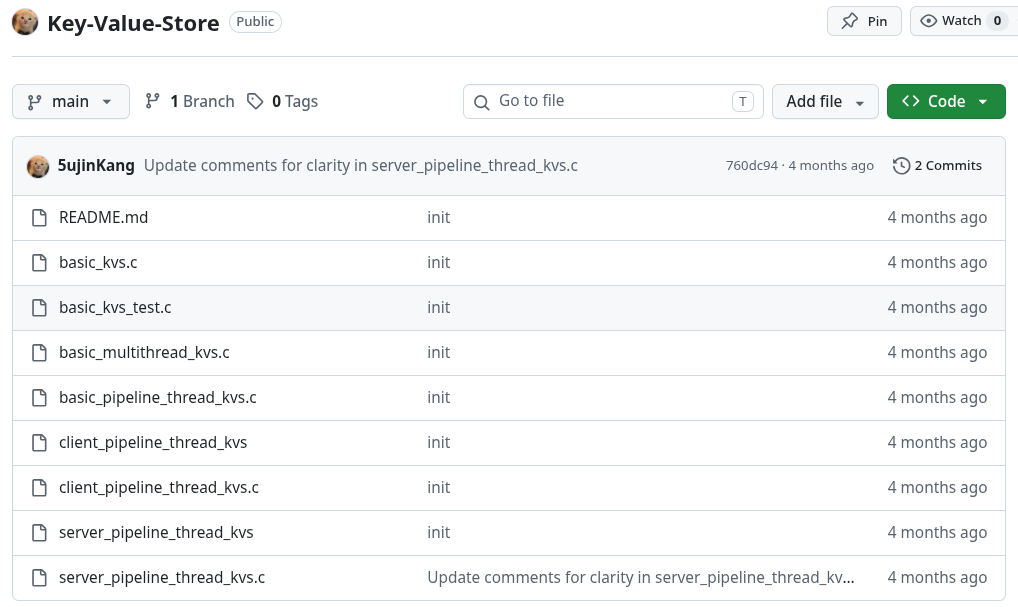
GitHub: 5ujinKang/Key-Value-Store
A Key-Value Store implemented from scratch in C, built in four progressive stages — from a basic single-threaded hash map up to a fully networked 3-stage pipeline server.
Overview
The project explores how a KVS can be made increasingly concurrent and scalable:
- Basic KVS — single-threaded hash map with per-bucket locks
- Multithreaded KVS — concurrent access with per-bucket mutex locking
- Pipeline KVS — 2-stage thread pipeline separating dispatch from execution
- Networked Pipeline KVS — 3-stage TCP server with a client
Stage 1: Basic Hash Map KVS
A hash table of 1024 buckets, each protected by a pthread_mutex_t. Entries are stored as linked lists within each bucket (chaining for collision resolution).
kv_set(key, value)— insert or updatekv_get(key, out)— lookupkvstore_destroy(&store)— full cleanup, nullifies the pointer after free
Per-bucket locking is used from the start, even in the single-threaded version, to set up a clean foundation for concurrent use.
Stage 2: Multithreaded KVS
Multiple threads concurrently call kv_set and kv_get. Since each bucket has its own mutex, threads only contend when they hash to the same bucket — giving fine-grained, high-throughput concurrency.
- 4 worker threads, each performing 5 GET/SET operations
- Keys are partitioned per thread; random GETs cross thread boundaries to test concurrent read correctness
Stage 3: 2-Stage Pipeline KVS
Operations are no longer executed directly by the calling thread. Instead, a pipeline decouples request dispatch from execution:
[Producer threads] → Queue → [Worker threads]
      Stage 1                     Stage 2
- Stage 1 (producers): receive operations, log them, forward to a bounded queue
- Stage 2 (workers): dequeue and execute actual
kv_set/kv_get - Queue uses
pthread_cond_tfor blocking push/pop — no busy-waiting OP_EXITsentinel propagates shutdown through the pipeline
Stage 4: Networked 3-Stage Pipeline KVS
A TCP server with a matching client, built on the pipeline design:
[Network receive]  →  Queue 1  →  [KV execution]  →  Queue 2  →  [Send response]
     Stage 1                         Stage 2                          Stage 3
     1 thread/client              3 threads                        3 threads
- Stage 1: one thread per client connection reads lines from the socket and enqueues
Requeststructs - Stage 2: 3 worker threads dequeue requests, parse
SET key value/GET keycommands, execute on the KVS, enqueueResponsestructs - Stage 3: 3 threads dequeue responses and send results back over the client socket
The client sends a sequence of SET and GET commands over TCP and prints the server’s responses.
Key Design Points
- Per-bucket locking: minimizes contention — only threads hashing to the same bucket compete
- Bounded queue with condition variables: producers block when the queue is full; consumers block when empty — clean backpressure without spinning
- Pipeline staging: cleanly separates I/O, computation, and response — each stage can be independently scaled
- Pointer-nullifying destroy:
kvstore_destroy(&store)sets the pointer toNULLafter freeing, preventing use-after-free bugs