Linux Kernel 7.1-rc2: Structural Analysis of Subsystems
Mapping 63,000+ source files across 16 subsystems — scheduler, memory, filesystems, networking, and beyond
Kernel version: Linux 7.1-rc2
Method: Structural analysis of the source tree — directory layout, file/line counts, cross-subsystem header dependencies.
Tree totals: 63,353 source files (36,679 .c, 26,674 .h)
Overview
The Linux kernel source tree is organized as a set of cooperating subsystems. Each lives in its own top-level directory and owns a well-defined responsibility. They interact through stable internal APIs, primarily header files under include/linux/, rather than direct coupling.
Below is a classification of all major subsystems derived directly from the 7.1-rc2 source tree.
Size by Subsystem
| Subsystem | Directory | .c files |
Lines of C |
|---|---|---|---|
| Device Drivers | drivers/ |
22,107 | ~17,896,000 |
| Architecture | arch/ |
4,248 | ~1,548,000 |
| Filesystems | fs/ |
1,482 | ~1,456,000 |
| Sound | sound/ |
1,872 | ~1,406,000 |
| Networking | net/ |
1,475 | ~1,233,000 |
| Memory Management | mm/ |
164 | ~210,000 |
| Kernel Core + Scheduler | kernel/ |
491 | ~515,000 |
| Security | security/ |
167 | ~112,000 |
| Block Layer | block/ |
75 | ~67,000 |
| Cryptographic API | crypto/ |
151 | ~67,000 |
| io_uring | io_uring/ |
43 | ~24,000 |
| Virtualization | virt/ |
11 | ~11,000 |
| IPC | ipc/ |
11 | ~9,600 |
Why the Extremes Are Extreme
Top 3 — why so large
Device Drivers (~17.9M lines) — The kernel must support every piece of hardware ever shipped. GPUs alone account for ~2.5M lines because each vendor (Intel, AMD, Nvidia) ships a programmable compute chip that is essentially its own computer — each needs its own compiler backend, firmware loader, and memory manager. Network drivers cover thousands of distinct NICs across ethernet, Wi-Fi, and virtual. The fundamental problem is a one-driver-per-device model: hardware differences cannot be abstracted away, so the code scales linearly with hardware diversity across decades of production.
Architecture (~1.55M lines) — Each ISA requires a full vertical slice: page tables, trap/exception handlers, context switch assembly, SMP bringup, FPU/SIMD save-restore, CPU feature detection, and platform boot code. x86 alone is enormous because it carries 40 years of backward compatibility — real mode, SMM, APIC variants, hundreds of CPU errata workarounds. 22 architectures × (large per-arch slice) = large total.
Filesystems (~1.46M lines) — Each of 86 filesystems has its own on-disk format, journal recovery logic, and cache coherency protocol. Network filesystems (NFS, SMB, Ceph) embed full network protocol stacks. Each is essentially a specialized database engine with its own consistency guarantees. Size scales with filesystem count.
Bottom 3 — why so small
IPC (~9,600 lines) — SysV message queues, semaphores, and shared memory are old, frozen, narrow-scoped interfaces. No hardware, no protocol complexity, no vendor variants. The API has been stable since the 1980s Unix era. Implementation is: a few data structures + locking + a handful of syscalls. Nothing new accumulates here.
Virtualization / virt/ (~11,000 lines) — This number is misleading. virt/ is intentionally a thin glue layer — just the architecture-independent KVM core (vCPU abstraction, memory slots, irqchip interface). The bulk of KVM lives elsewhere: arch/x86/kvm/ holds all the VMX/SVM logic, nested virtualization, and shadow paging; virtio lives in drivers/virtio/; vhost lives in drivers/vhost/. The directory boundary understates KVM’s real footprint by roughly 10×.
io_uring (~24,000 lines) — io_uring is a clean, modern interface layer, not an implementation. Introduced in 5.1 (2019), it was designed from scratch as a shared ring buffer (submission queue + completion queue). It delegates all actual work to existing subsystems — file I/O goes through VFS, networking goes through net/, etc. It adds no new I/O semantics, only a new dispatch mechanism. Being new also means zero legacy cruft has accumulated yet.
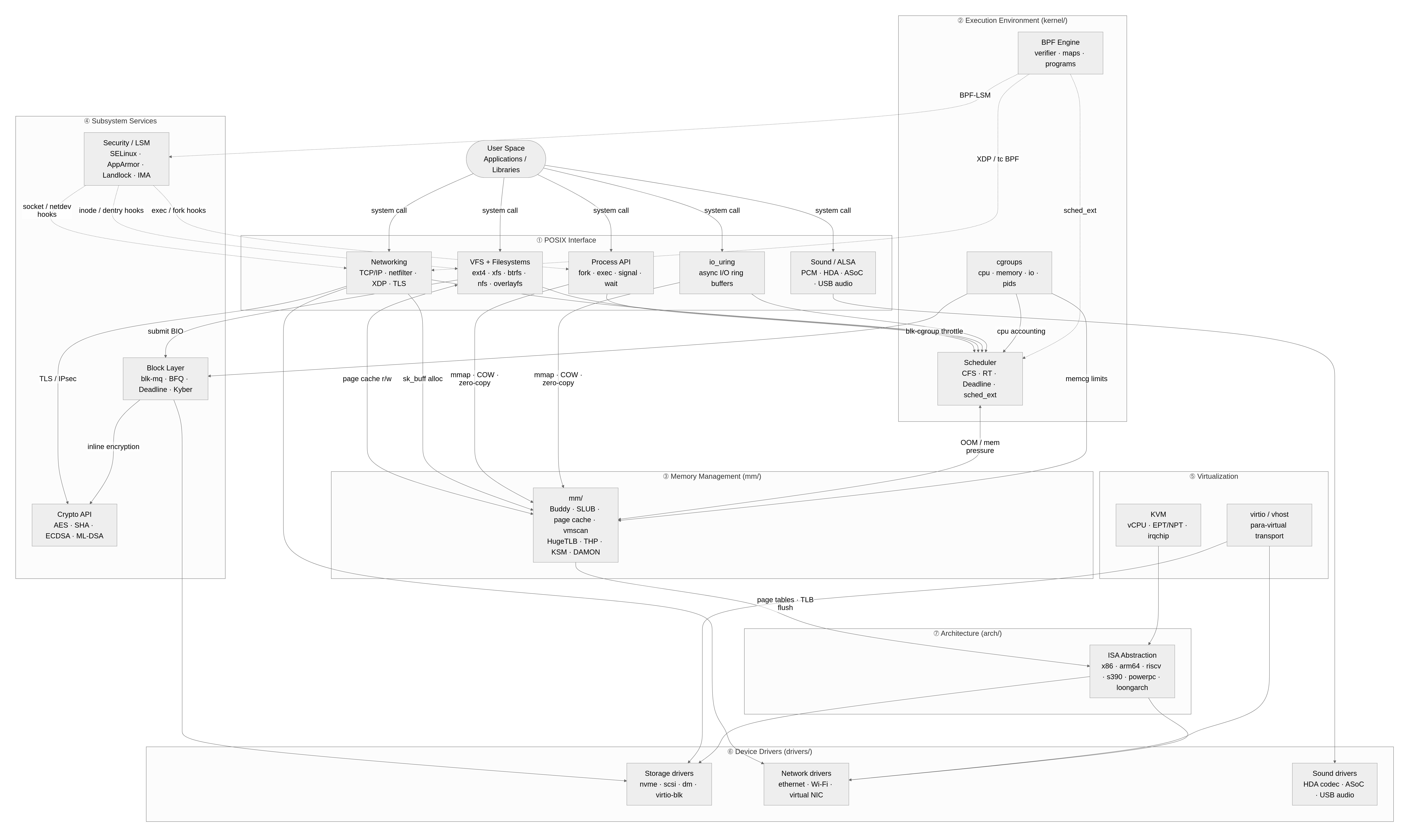
Subsystem Workflow Graph
The diagram below shows primary data/control flows (solid arrows) and cross-cutting hook relationships (dashed arrows) across all seven layers of the kernel.
Reading the graph:
Solid arrows show primary data or control flow. Dashed arrows (-.->) show cross-cutting hook relationships — BPF programs attach into subsystems without the subsystem knowing, and LSM hooks intercept operations at the VFS/net/process boundary.
Cross-Subsystem Interaction
The subsystems are not isolated. Key coupling points:
include/linux/sched.his included by 98 files inkernel/and 49 files innet/—struct task_structis the universal process handle.include/linux/mm.his included by 69 files inkernel/and 619 files indrivers/— memory allocation is universal.include/linux/fs.his included by 48 files inkernel/— the VFS inode/file model touches nearly everything.- LSM hooks crosscut all subsystems without any subsystem importing another.
- BPF appears in
kernel/bpf/,net/bpf/,security/bpf/,io_uring/bpf_filter.c,kernel/sched/ext.c— it is a horizontal layer, not a single subsystem.
Subsystem Details
1. Process & Execution Management — kernel/
The kernel core manages process lifecycle, system calls, and cross-cutting concerns.
- Process lifecycle —
fork.c,exit.c:clone()/fork()/execve() - Signal handling —
signal.c(5,053 lines): POSIX signals - Workqueues —
workqueue.c(8,439 lines): async kernel thread pool; largest single file inkernel/ - Audit —
audit.c,auditsc.c,auditfilter.c: syscall auditing - Credentials —
cred.c,user_namespace.c: UID/GID, user namespaces - BPF engine —
bpf/(~30 files): eBPF verifier, maps, program types - cgroups —
cgroup/: resource grouping (cpu, memory, pids, rdma, dmem) - Tracing —
trace/,kprobes.c: live kernel instrumentation
2. Scheduler — kernel/sched/
Self-contained subdirectory, ~60,000 lines. Four scheduling classes in priority order:
| Class | File | Lines | Policy |
|---|---|---|---|
| Stop | stop_task.c |
— | Highest priority; used for CPU hotplug |
| Deadline | deadline.c |
3,872 | SCHED_DEADLINE (EDF) |
| RT | rt.c |
2,939 | SCHED_FIFO / SCHED_RR |
| Fair (CFS) | fair.c |
14,282 | Default; largest scheduler file |
| Ext (BPF) | ext.c |
9,821 | sched_ext — BPF-programmable (new in 6.11) |
| Idle | idle.c |
— | Lowest priority |
sched_ext inserts between RT and Fair and allows user-written BPF programs to implement custom scheduling policies entirely from userspace — a major architectural shift.
3. Memory Management — mm/
164 .c files, ~210,000 lines. Key components:
- Buddy allocator —
page_alloc.c(7,800 ln): zone-based physical page allocator - SLUB —
slub.c(9,936 ln): kernel object cache; the largest file inmm/ - Page fault handler —
memory.c(7,587 ln): demand paging, COW, anonymous mappings - Page reclaim —
vmscan.c(8,068 ln): kswapd, LRU-based eviction - HugeTLB / THP —
hugetlb.c(7,324 ln),huge_memory.c(5,093 ln) - Memory cgroups —
memcontrol.c(5,958 ln): per-cgroup accounting and limits - KSM —
ksm.c(4,021 ln): Kernel Samepage Merging (deduplication) - DAMON —
damon/(12 files): Data Access MONitor for proactive memory management - Safety tools —
kasan/,kfence/: dynamic memory error detection
4. Virtual File System & Filesystems — fs/
1,482 .c files, ~1,456,000 lines. The VFS core (dcache.c, inode.c, namei.c, super.c) provides a unified abstraction over 86 filesystem implementations:
| Category | Filesystems |
|---|---|
| General-purpose | ext4, xfs, btrfs, f2fs, jfs, ext2 |
| Network/distributed | nfs, nfsd, ceph, smb, afs, 9p |
| Flash/embedded | jffs2, ubifs, erofs, squashfs, cramfs |
| Windows-compat | fat, exfat, ntfs, ntfs3, hfs, hfsplus |
| Pseudo/virtual | proc, sysfs, debugfs, tracefs, configfs |
| Special-purpose | overlayfs, fuse, hugetlbfs, devpts |
| Cluster | gfs2, ocfs2 (with DLM) |
| Integrity | ecryptfs, verity (dm-verity), fscrypt |
5. Networking — net/
1,475 .c files, ~1,233,000 lines. Layered protocol stack:
- Socket layer —
net/core/,socket.c: BSD socket API,sk_bufflifecycle - IPv4 / IPv6 —
net/ipv4/,net/ipv6/: TCP, UDP, ICMP, routing - Netfilter —
net/netfilter/:nftables/iptablespacket filtering framework - Wireless —
net/wireless/,net/mac80211/: cfg80211 + 802.11 MAC - XDP/BPF —
net/bpf/,net/xdp/: eXpress Data Path for line-rate packet processing - Traffic control —
net/sched/:tcqdisc/classifier framework - MPTCP —
net/mptcp/: Multipath TCP - Kernel TLS —
net/tls/: in-kernel TLS record layer - OpenvSwitch —
net/openvswitch/: in-kernel OVS datapath - Protocols — tipc, sctp, rxrpc, can, l2tp, mctp, mpls, smc
6. Device Drivers — drivers/
22,107 .c files, ~17.9M lines — the largest subsystem by a wide margin.
| Category | Lines | Notes |
|---|---|---|
| Graphics / GPU | ~2,530,000 | DRM framework; i915, amdgpu, nouveau, virtio-gpu |
| Network drivers | ~4,268,000 | Ethernet, Wi-Fi, virtual NICs, DSA |
| SCSI / storage | ~848,000 | libfc, lpfc, megaraid, qla2xxx |
| Media | ~1,327,000 | V4L2, DVB, camera sensors |
| USB | ~525,000 | XHCI/EHCI host controllers, device classes |
| Input | ~211,000 | evdev, keyboard, mouse, touchscreen |
| HID | ~139,000 | USB/Bluetooth HID, hid-bpf |
| PCI | ~163,000 | PCIe core, AER, hotplug |
| NVMe | ~55,000 | NVMe PCIe and fabrics |
7. Architecture — arch/
22 architectures, 4,248 .c files, ~1.55M lines. Each provides: page table management, trap/exception handlers, context switch, boot code, and include/asm/ abstractions.
| Architecture | Notes |
|---|---|
| x86 / x86_64 | Primary desktop/server; most complex arch port |
| arm64 | Dominant in mobile and cloud servers |
| riscv | Fast-growing open ISA |
| powerpc | IBM servers and embedded |
| s390 | IBM Z mainframes |
| loongarch | Chinese open ISA (added in 5.19) |
8. Security — security/
167 .c files, ~112,000 lines. The LSM hook framework (lsm_init.c, security.c) inserts call sites throughout the kernel; individual modules register handlers selectively.
| Module | Mechanism |
|---|---|
| SELinux | Type enforcement MAC |
| AppArmor | Path-based MAC |
| Smack | Simplified labels |
| Landlock | Unprivileged sandboxing |
| IPE | Integrity Policy Enforcement |
| IMA/EVM | File measurement and appraisal |
| Keys | Kernel keyring subsystem |
9. Block Layer — block/
75 .c files, ~67,000 lines. Sits between filesystems and storage drivers.
- Multi-queue I/O dispatch (
blk-mq.c): maps I/O requests to hardware queues - I/O schedulers: BFQ (
bfq-iosched.c), Deadline (mq-deadline.c), Kyber (kyber-iosched.c) - Block cgroups: per-cgroup I/O accounting and throttling
- Inline encryption (
blk-crypto.c) and zoned storage (blk-zoned.c)
10. Cryptographic API — crypto/
151 .c files, ~67,000 lines. Algorithm-agnostic framework: symmetric ciphers (AES, ChaCha20), hashes (SHA-{1,2,3}, BLAKE2b, SM3), MACs, AEAD, asymmetric keys (RSA, ECDSA), RNG, and ML-DSA (FIPS 204 post-quantum signature).
11. Sound — sound/
1,872 .c files, ~1,406,000 lines. Comparable in size to fs/ and net/.
- ALSA core — PCM, control, mixer abstractions
- HD Audio —
hda/: codec driver framework for Intel/AMD HDA - ASoC —
soc/: embedded audio (CPU DAI + CODEC + machine driver model) - USB Audio — UAC class driver
- OSS — legacy compatibility layer
12. io_uring — io_uring/
43 .c files, ~24,000 lines. Asynchronous I/O via shared ring buffers (submission queue + completion queue). Implements file I/O (rw.c), networking (net.c), splice, futex, epoll, zero-copy receive (zcrx.c), and BPF-based request filtering.
13. Virtualization — virt/
- KVM core (
virt/kvm/): vCPU management, memory slots, irqchip abstraction - KVM x86 (
arch/x86/kvm/): VMX (Intel) and SVM (AMD) hardware virtualization - vhost (
drivers/vhost/): userspace virtio backend acceleration in-kernel - virtio (
drivers/virtio/): para-virtual device transport (PCI, MMIO, CCW)
14. IPC — ipc/
11 .c files, ~9,600 lines. Classic SysV and POSIX IPC primitives: message queues (msg.c), semaphores (sem.c), shared memory (shm.c), POSIX mqueues (mqueue.c).
15. Rust Subsystem — rust/
New in 6.1, growing actively in 7.x. Provides safe Rust bindings to kernel primitives: allocators, block layer, device model, debugfs, cpufreq, configfs, cpumask, clk, credentials. Enables writing drivers and kernel modules in safe Rust.
Three Primary I/O Paths
The workflow graph above traces three dominant paths through the kernel:
File I/O path
User →
read()/write()→ VFS (dentry/inode lookup) → page cache (mm) →submit_bio()→ Block layer (I/O scheduler) → storage driver → hardware
Network path
User →
send()/recv()→ socket layer → TCP/IP stack →sk_buff(mm) → netdev queue → network driver → NIC
Process execution path
User →
execve()/fork()→ kernel/process mgmt → scheduler (CFS/RT/sched_ext) → demand paging (mm) → page tables (arch) → TLB
All three paths are subject to cgroup resource accounting at each stage (CPU, memory, block I/O), and LSM hooks intercept at each syscall entry point.
Phase 3: Subsystem Interaction Scenarios
The following three scenarios trace real kernel execution paths derived from direct source analysis of Linux 7.1-rc2. Every function name, file path, and line number was verified against the actual source tree at /home/user/linux.
Scenario 1: Process Scheduling
Overview
The Linux scheduler decides which task runs on a CPU and when to switch away from it. This section traces the full path from a hardware timer tick to the moment a new task starts executing.
Step 1 — The timer fires. A hardware clock interrupts the CPU every ~4 ms (250 times per second). Each interrupt calls sched_tick(), which asks: has the current task been running long enough?
Step 2 — Tracking fairness with virtual runtime. Each task accumulates a counter called vruntime — the total CPU time it has consumed, normalized by its priority weight. Higher-priority tasks accumulate vruntime more slowly, so they stay runnable longer. When vruntime exceeds the task’s assigned deadline, the scheduler marks it for replacement by setting a flag called TIF_NEED_RESCHED on the CPU.
Step 3 — The flag is a signal, not an immediate switch. The kernel cannot safely swap tasks mid-instruction. Instead, TIF_NEED_RESCHED is checked at two safe moments: when the task voluntarily goes to sleep (waiting for I/O, a lock, etc.), or when control returns to userspace after an interrupt or syscall completes. At either point, schedule() is invoked.
Step 4 — Picking the next task. __schedule() walks a priority-ordered list of scheduling classes — stop → deadline → real-time → fair (CFS) → idle — and asks each class for its best runnable task. Within the CFS class, pick_next_task_fair() selects the task with the smallest vruntime from a red-black tree, meaning the task that has received the least CPU time relative to its peers.
Step 5 — The context switch. context_switch() performs two operations to hand the CPU to the new task: first, it loads the new task’s memory map (switch_mm_irqs_off() — updates the CPU’s page table pointer CR3, so the CPU can access the new task’s memory); second, it saves all CPU registers for the old task and restores them for the new task (__switch_to() — includes stack pointer, floating-point state, and segment registers). After this, the CPU is executing the new task’s code as if it had never stopped.
Key Functions
| Function | File | Line | Role |
|---|---|---|---|
update_process_times() |
kernel/time/timer.c |
2468 | Timer IRQ bottom: accounts CPU time, calls sched_tick() |
sched_tick() |
kernel/sched/core.c |
5636 | Per-tick scheduler accounting; calls sched_class→task_tick() |
task_tick_fair() |
kernel/sched/fair.c |
13657 | CFS tick handler; calls entity_tick() for each sched entity in group hierarchy |
update_curr() |
kernel/sched/fair.c |
1378 | Computes elapsed time, increments vruntime += calc_delta_fair(Δt, se) |
resched_curr() |
kernel/sched/core.c |
1212 | Sets TIF_NEED_RESCHED on target CPU, triggering future preemption |
resched_curr_lazy() |
kernel/sched/core.c |
1238 | Lazy variant: sets TIF_NEED_RESCHED_LAZY if lazy preemption is active |
schedule() |
kernel/sched/core.c |
7273 | Public entry: flushes block plug, calls __schedule_loop() |
__schedule() |
kernel/sched/core.c |
7017 | Core scheduler: disables IRQs, acquires rq lock, dequeues sleeping prev, calls pick_next_task() |
__pick_next_task() |
kernel/sched/core.c |
5999 | Walks for_each_active_class() vtable in priority order until a task is found |
pick_next_task_fair() |
kernel/sched/fair.c |
9204 | CFS picker: calls pick_task_fair() → leftmost node of CFS red-black tree |
_pick_next_task_rt() |
kernel/sched/rt.c |
1694 | RT picker: takes highest-prio task from the RT run-list |
context_switch() |
kernel/sched/core.c |
5329 | Switches MM (switch_mm_irqs_off), then calls switch_to() macro |
__switch_to() |
arch/x86/kernel/process_64.c |
610 | x86-64 arch switch: saves/restores FPU, TLS, FS/GS segments, swaps RSP via CALL/RET |
finish_task_switch() |
kernel/sched/core.c |
5202 | Releases rq lock, drops reference to prev task, fires sched_in perf notifiers |
try_to_wake_up() |
kernel/sched/core.c |
4152 | Wakeup path: validates state, calls ttwu_queue() → activate_task() → enqueue_task_fair() |
activate_task() |
kernel/sched/core.c |
2200 | Inserts task into runqueue via sched_class→enqueue_task() |
ttwu_queue() |
kernel/sched/core.c |
3968 | Queues wakeup IPI if target CPU is remote; local: directly enqueues |
sched_balance_rq() |
kernel/sched/fair.c |
12071 | Periodic load balancer: migrates tasks between CPUs |
sched_balance_find_src_rq() |
kernel/sched/fair.c |
11753 | Finds the busiest runqueue as migration source |
detach_tasks() |
kernel/sched/fair.c |
9874 | Removes tasks from source rq for cross-CPU migration |
attach_tasks() |
kernel/sched/fair.c |
10013 | Enqueues migrated tasks onto destination rq |
sched_balance_newidle() |
kernel/sched/fair.c |
5032 | Idle-CPU load balance: pulls tasks when a CPU goes idle |
Complete Call Chain
Tick-driven preemption path:
- Hardware timer fires → CPU exception →
update_process_times()(timer.c:2468) — accounts user/kernel time viaaccount_process_tick(), then callssched_tick(). sched_tick()(core.c:5636) — acquiresrqlock, updatesrq_clock, callsdonor->sched_class->task_tick(rq, donor, 0).task_tick_fair()(fair.c:13657) — iterates thesched_entitygroup hierarchy, callingentity_tick(cfs_rq, se, queued)at each level.entity_tick()→update_curr()(fair.c:1378) —delta_exec = update_se(rq, curr); thencurr->vruntime += calc_delta_fair(delta_exec, curr); callsupdate_deadline().- If deadline exceeded:
resched_curr_lazy(rq)(core.c:1238) — setsTIF_NEED_RESCHED/TIF_NEED_RESCHED_LAZYflag on the running CPU. - On return from interrupt (or at next
cond_resched()):schedule()(core.c:7273) orpreempt_schedule()(core.c:7386) is invoked. schedule()→__schedule_loop()→__schedule(SM_NONE)(core.c:7017) — disables IRQs, acquiresrq->lockviarq_lock().- If prev is blocking:
try_to_block_task()— sets prev state, callsdeactivate_task()to remove from rq. pick_next_task(rq, donor, &rf)(core.c:7105) →__pick_next_task()(core.c:5999).__pick_next_task()fast path: if all tasks are CFS, directly callspick_next_task_fair(rq, prev, rf). Otherwisefor_each_active_class(class)walks stop → dl → rt → fair → idle, callingclass->pick_next_task()orclass->pick_task().pick_next_task_fair()(fair.c:9204) →pick_task_fair(rq, rf)— selectssefromcfs_rq->tasks_timeline(rb_root_cached, leftmost = min vruntime). For cgroup fair-group scheduling, walks the entity tree viaset_next_entity()andput_prev_entity().context_switch(rq, prev, next, &rf)(core.c:5329):prepare_task_switch(rq, prev, next)— fires preemption notifiers.arch_start_context_switch(prev).- If switching to a user task:
switch_mm_irqs_off(prev->active_mm, next->mm, next)— loads new CR3, flushes TLB if ASID differs;lru_gen_use_mm(next->mm). prepare_lock_switch(rq, next, &rf)— releases rq lock (lock is transferred to next task).switch_to(prev, next, prev)macro →__switch_to(prev_p, next_p)(process_64.c:610): saves/restores FPU state (switch_fpu()), saves FS/GS segment registers (save_fsgs()), loads next’s TLS (load_TLS(next, cpu)), switches I/O bitmap, swaps kernel stack pointer.
- CPU now executes the next task’s kernel stack.
finish_task_switch(prev)(core.c:5202) is called on the new task’s behalf — releasesrq->lock, dropsprev->active_mmif needed, callsperf_event_task_sched_in(), firessched_innotifiers.
Wake-up path (e.g., I/O completion wakes a sleeping task):
try_to_wake_up(p, state, wake_flags)(core.c:4152) — acquiresp->pi_lock, checksp->__statematchesstate.ttwu_queue(p, cpu, wake_flags)(core.c:3968) — if remote CPU: queues via__smp_call_single_queue()(IPI). If local: directly callsttwu_do_activate().activate_task(rq, p, flags)(core.c:2200) — callssched_class->enqueue_task(), e.g.enqueue_task_fair()(fair.c:7168) — insertsseintocfs_rq->tasks_timelineRB-tree at the computed vruntime position.wakeup_preempt(rq, p, flags)— checks if newly woken task should preempt current; if so, callsresched_curr().
Cross-CPU load balancing:
sched_balance_newidle()(fair.c:5032) is called frompick_next_task_fair()when no local task is available — pulls tasks from the busiest runqueue.- Periodic
sched_balance_rq()(fair.c:12071) runs viasched_balance_trigger()called fromsched_tick(). - →
sched_balance_find_src_rq()(fair.c:11753) — iterates sched domains to find the busiest group and queue. - →
detach_tasks()(fair.c:9874) — removes tasks from source rq. - →
attach_tasks()(fair.c:10013) — enqueues them on the destination rq.
Key Data Structures
struct sched_entity (include/linux/sched.h:575)
The per-task CFS accounting unit embedded in task_struct.se.
| Field | Type | Role |
|---|---|---|
vruntime |
u64 |
Accumulated virtual runtime (ns × weight-normalized) |
deadline |
u64 |
Absolute deadline for current slice (EEVDF scheduler) |
run_node |
struct rb_node |
Node in the per-cfs_rq red-black tree |
exec_start |
u64 |
Timestamp of last scheduling-in (used to compute Δt) |
sum_exec_runtime |
u64 |
Total physical CPU time consumed |
on_rq |
unsigned char |
1 if currently enqueued on a runqueue |
load.weight |
unsigned long |
Proportional weight derived from nice value |
struct rq (kernel/sched/sched.h:1131)
Per-CPU runqueue; one per logical CPU.
| Field | Type | Role |
|---|---|---|
nr_running |
unsigned int |
Total runnable tasks on this CPU |
curr / donor |
struct task_struct * |
Currently executing / scheduling-context task |
cfs |
struct cfs_rq |
Embedded CFS runqueue (holds RB-tree) |
rt |
struct rt_rq |
Real-time runqueue |
dl |
struct dl_rq |
Deadline runqueue |
__lock |
raw_spinlock_t |
Runqueue lock |
struct task_struct — scheduling-relevant fields (include/linux/sched.h:820):
sched_class (pointer to vtable), se (CFS entity), rt (RT entity), policy (SCHED_NORMAL/FIFO/RR/DEADLINE), prio / static_prio / normal_prio, on_rq, on_cpu, cpus_ptr (allowed CPU mask).
sched_class vtable for fair_sched_class (fair.c:14177):
DEFINE_SCHED_CLASS(fair) = {
    .enqueue_task   = enqueue_task_fair,
    .dequeue_task   = dequeue_task_fair,
    .pick_task      = pick_task_fair,
    .pick_next_task = pick_next_task_fair,
    .put_prev_task  = put_prev_task_fair,
    .set_next_task  = set_next_task_fair,
    .task_tick      = task_tick_fair,
    .select_task_rq = select_task_rq_fair,
    .wakeup_preempt = wakeup_preempt_fair,
};
Priority order: stop_sched_class (stop_task.c:99) > dl_sched_class (deadline.c:3421) > rt_sched_class (rt.c:2595) > fair_sched_class (fair.c:14177) > idle_sched_class (idle.c:569).
Process Scheduling Flow Graph
(250 Hz / 4ms period)"] A --> B["update_process_times()
kernel/time/timer.c:2468"] B --> C["sched_tick()
kernel/sched/core.c:5636
Holds rq lock; updates clock & hw_pressure"] C --> D["sched_class→task_tick(rq, curr, 0)
Dispatches to active scheduling class"] D --> E["task_tick_fair()
kernel/sched/fair.c:13657
Iterates sched_entity group hierarchy"] E --> F["update_curr()
fair.c:1378
delta_exec = now − exec_start
vruntime += calc_delta_fair(delta_exec, se)"] F --> G{update_deadline:
deadline exceeded?} G -->|No| H["Task continues running"] G -->|Yes| I["resched_curr_lazy()
core.c:1238
Sets TIF_NEED_RESCHED flag"] I --> J["schedule() entry
core.c:7273
or preempt_schedule() core.c:7386"] J --> K["__schedule(SM_NONE)
core.c:7017
Disables IRQs · acquires rq lock
Deactivates blocking prev task"] K --> L["pick_next_task()
→ __pick_next_task()
core.c:5999"] L --> M["for_each_active_class priority walk"] M --> M1["stop_sched_class
stop_task.c:99"] M --> M2["dl_sched_class
deadline.c:3421"] M --> M3["rt_sched_class → _pick_next_task_rt()
rt.c:1694"] M --> M4["fair_sched_class"] M4 --> N["pick_next_task_fair()
fair.c:9204
→ pick_task_fair()
→ leftmost rb_node (min vruntime)"] N --> O["context_switch()
core.c:5329"] O --> O1["switch_mm_irqs_off()
Load CR3, flush TLB if ASID differs"] O1 --> O2["switch_to() macro
→ __switch_to()
arch/x86/kernel/process_64.c:610
FPU · TLS · FS/GS · kernel RSP"] O2 --> P["finish_task_switch()
core.c:5202
Release rq lock · drop prev ref
Fire sched_in perf notifiers"] P --> Q["✅ Next task resumes execution"] H -.->|"next timer tick"| A subgraph WAKEUP["Wake-up Path"] W1["try_to_wake_up()
core.c:4152"] --> W2["ttwu_queue()
core.c:3968
IPI if remote CPU"] W2 --> W3["activate_task()
core.c:2200
→ enqueue_task_fair()
Insert se into CFS RB-tree"] W3 --> W4["wakeup_preempt()
→ resched_curr() if higher prio"] end W4 -.->|"TIF_NEED_RESCHED set"| J
Scenario 2: Memory Management
Overview
Memory management covers how the kernel gives programs the memory they ask for, and how it takes memory back when the system runs low. This section traces three paths that work together continuously.
Path A — Page fault: giving a program its memory on demand. When a program accesses a memory address that has no physical RAM assigned to it yet, the CPU raises a hardware exception called a page fault. The kernel’s fault handler walks the program’s page table to find out why the page is missing, then decides what to do: for a brand-new anonymous page (e.g. a freshly written variable), it allocates a physical page and maps it in; for a copy-on-write page (e.g. after fork()), it copies the parent’s page before allowing the write; for a page that was swapped out to disk, it reads it back from the swap device. The program never sees any of this — from its perspective the memory access simply succeeds.
Path B — Buddy allocator + SLUB: the kernel’s internal memory supply. Every time the kernel itself needs memory — for data structures, driver buffers, page tables — it calls kmalloc(). The SLUB slab allocator sits on top and maintains per-CPU caches of fixed-size objects so that common allocations are lock-free and nearly instant. When a cache is empty, SLUB asks the buddy allocator for a fresh page. The buddy allocator manages all free physical pages grouped by size (powers of two), splitting and merging blocks to satisfy requests. If free memory falls below a threshold, the slow path wakes kswapd before retrying.
Path C — kswapd: reclaiming memory in the background. The kernel tracks all physical pages on LRU (Least Recently Used) lists — pages that have not been accessed recently drift toward the “inactive” end. A kernel thread called kswapd runs whenever free memory drops below a watermark. It scans the inactive list, and for each page it finds: if the page is clean (no unsaved changes), it is simply freed; if the page is dirty (modified but not yet written to disk), it is written back to its backing file or swap device first, then freed. This keeps a pool of free pages available so that page faults can be satisfied quickly without stalling.
Key Functions
| Function | File | Line | Role |
|---|---|---|---|
exc_page_fault() |
arch/x86/mm/fault.c |
1483 | IDT raw entry for #PF exception; calls handle_page_fault() |
handle_page_fault() |
arch/x86/mm/fault.c |
1462 | Routes to do_kern_addr_fault() or do_user_addr_fault() |
do_user_addr_fault() |
arch/x86/mm/fault.c |
1207 | Validates fault context, finds VMA via lock_mm_and_find_vma(), calls handle_mm_fault() |
handle_mm_fault() |
mm/memory.c |
6683 | MM entry: dispatches to hugetlb_fault() or __handle_mm_fault() |
__handle_mm_fault() |
mm/memory.c |
6449 | Walks page table levels (pgd→p4d→pud→pmd), allocating missing table pages; calls handle_pte_fault() |
handle_pte_fault() |
mm/memory.c |
6367 | Decodes PTE state and dispatches: missing, swap, NUMA, or write-protect |
do_pte_missing() |
mm/memory.c |
4545 | Dispatches anonymous vs. file-backed missing page |
do_anonymous_page() |
mm/memory.c |
5321 | Anonymous fault: maps zero-page for reads; for writes: alloc_anon_folio() + set_pte_at() |
do_wp_page() |
mm/memory.c |
4228 | Write-protect fault: determines if COW is needed, calls do_cow_fault() |
do_cow_fault() |
mm/memory.c |
5905 | Copy-on-Write: folio_prealloc() → __do_fault() → copy_mc_user_highpage() → finish_fault() |
do_swap_page() |
mm/memory.c |
4779 | Swap-in: reads page from swap device, installs PTE |
__alloc_frozen_pages_noprof() |
mm/page_alloc.c |
5190 | Core physical allocator: fast path via get_page_from_freelist(), slow path via __alloc_pages_slowpath() |
__alloc_pages_noprof() |
mm/page_alloc.c |
5255 | Public buddy allocator entry; wraps __alloc_frozen_pages_noprof(), marks page refcounted |
get_page_from_freelist() |
mm/page_alloc.c |
3792 | Scans zonelist for a zone with free pages above watermark |
rmqueue_buddy() |
mm/page_alloc.c |
3203 | Dequeues a page from the buddy free list; splits higher-order blocks if needed |
__alloc_pages_slowpath() |
mm/page_alloc.c |
4687 | Slow path: retries with lower watermark, wakes kswapd, tries direct reclaim, invokes OOM killer |
wakeup_kswapd() |
mm/vmscan.c |
7519 | Wakes the per-node kswapd thread when zone falls below WMARK_LOW |
kswapd() |
mm/vmscan.c |
7438 | Per-NUMA-node kthread: sleeps until woken, calls balance_pgdat() |
balance_pgdat() |
mm/vmscan.c |
7108 | Drives reclaim loop for a pgdat at decreasing priority until watermarks are restored |
shrink_node() |
mm/vmscan.c |
6190 | Per-node reclaim; calls shrink_node_memcgs() for each memory cgroup |
shrink_lruvec() |
mm/vmscan.c |
5920 | Per-lruvec LRU scan: computes scan counts, calls shrink_list() for each evictable LRU |
shrink_inactive_list() |
mm/vmscan.c |
1951 | Isolates pages from inactive LRU, calls shrink_page_list() to reclaim them |
shrink_active_list() |
mm/vmscan.c |
2068 | Demotes active pages to inactive LRU |
pageout() |
mm/vmscan.c |
653 | Writes dirty pages back to their backing store via mapping->a_ops->writepage() |
__kmalloc_noprof() |
mm/slub.c |
5305 | SLUB entry for kmalloc(); calls __do_kmalloc_node() |
___slab_alloc() |
mm/slub.c |
4405 | SLUB slow path: tries get_from_partial(), then new_slab() → alloc_pages() |
Complete Call Chain
A. Page Fault Path (anonymous demand paging):
- CPU raises
#PF(interrupt vector 14) →exc_page_fault()(fault.c:1483) — readsCR2for faulting address, callsirqentry_enter(), thenhandle_page_fault(). handle_page_fault()(fault.c:1462) — checks if kernel or user address; callsdo_user_addr_fault()for userspace faults.do_user_addr_fault()(fault.c:1207) — enables IRQs (local_irq_enable()), callslock_mm_and_find_vma()to locate thevm_area_structcovering the faulting address, validates permissions viaaccess_error().handle_mm_fault(vma, address, flags, regs)(memory.c:6683) — activates memcg OOM tracking, dispatches tohugetlb_fault()for huge pages or__handle_mm_fault()for normal pages.__handle_mm_fault()(memory.c:6449) — allocates page table pages at each level:pgd_offset()→p4d_alloc()→pud_alloc()→pmd_alloc(). Checks for THP at PUD/PMD level. Falls through tohandle_pte_fault().handle_pte_fault()(memory.c:6367) — maps the PTE for inspection. Dispatches:- PTE absent →
do_pte_missing()(memory.c:4545) → for anonymous!VM_SHAREDVMA:do_anonymous_page(). - PTE present but write-protected →
do_wp_page()(memory.c:4228). - PTE encoded as swap entry →
do_swap_page().
- PTE absent →
do_anonymous_page()(memory.c:5321):- Read fault: maps the shared zero page (
pte_mkspecial(pfn_pte(zero_pfn, prot))), installs viaset_pte_at(). - Write fault:
alloc_anon_folio(vmf)→ buddy allocator → zeroed page,set_pte_at()installs writable PTE,update_mmu_cache().
- Read fault: maps the shared zero page (
B. Copy-on-Write (write to shared/read-only page):
do_wp_page()(memory.c:4228) — detects write to a read-only PTE.do_cow_fault()(memory.c:5905):folio_prealloc()— allocates a new page via buddy allocator.__do_fault()— callsvma->vm_ops->fault()to populate the original page.copy_mc_user_highpage(cow_page, original_page, addr, vma)— machine-check-aware page copy.finish_fault()— installs the new private writable PTE.
C. Buddy Allocator Path (kernel kmalloc):
kmalloc(size, GFP_KERNEL)→__kmalloc_noprof()(slub.c:5305) →__do_kmalloc_node().- SLUB fast path: checks per-CPU freelist of matching
kmem_cache. If non-empty, returns object with a single pointer dereference (lock-free). - SLUB slow path:
___slab_alloc()(slub.c:4405):get_from_partial(s, node, &pc)— tries the per-node partial slab list.new_slab(s, gfpflags, node)— allocates a fresh slab page from buddy: callsalloc_pages().
alloc_pages()→__alloc_pages_noprof()(page_alloc.c:5255) →__alloc_frozen_pages_noprof()(page_alloc.c:5190).- Fast path:
get_page_from_freelist(gfp, order, ALLOC_WMARK_LOW, &ac)(page_alloc.c:3792) — iterates the zone list, checkszone_watermark_fast(), callsrmqueue_buddy()(page_alloc.c:3203) which dequeues fromzone->free_area[order]and splits higher-order blocks viaexpand(). - Slow path (
__alloc_pages_slowpath(),page_alloc.c:4687):- Wakes kswapd:
wakeup_kswapd(zone, gfp_mask, reclaim_order, highest_zoneidx). - Retries
get_page_from_freelist()withALLOC_WMARK_MIN. - Direct reclaim:
try_to_free_pages(). - OOM:
out_of_memory(&oc)(page_alloc.c:4116) →oom_kill_process()as last resort.
- Wakes kswapd:
D. kswapd Reclaim Path:
wakeup_kswapd()(vmscan.c:7519) — wakes the per-NUMA-nodekswapdkthread.kswapd()(vmscan.c:7438) — main loop: callskswapd_try_to_sleep()to block until watermarks drop, then invokesbalance_pgdat().balance_pgdat(pgdat, order, highest_zoneidx)(vmscan.c:7108) — outer reclaim loop: decrementssc.priorityfromDEF_PRIORITY(12) toward 0, callingshrink_node()each iteration until the zone’s watermarks are restored.shrink_node()(vmscan.c:6190) →shrink_node_memcgs()(vmscan.c:6111) — iterates memory cgroups, callsshrink_lruvec()for each.shrink_lruvec(lruvec, sc)(vmscan.c:5920) — computes per-LRU scan counts viaget_scan_count(), then loops callingshrink_list(lru, nr_to_scan, lruvec, sc)for each of the four LRU lists (inactive_anon, active_anon, inactive_file, active_file).shrink_inactive_list()(vmscan.c:1951):isolate_lru_folios()— removes up toSWAP_CLUSTER_MAX(32) pages from LRU into a local list.shrink_page_list()— for each isolated page: tries to unmap (try_to_unmap()), reclaim, or write back.pageout()(vmscan.c:653) — for dirty file pages: callsmapping->a_ops->writepage()to submit I/O.
shrink_active_list()(vmscan.c:2068) — rotates unreferenced active pages to the inactive list for future reclaim.
Key Data Structures
struct page / struct folio (include/linux/mm_types.h:79)
The fundamental unit of physical memory. A folio is a power-of-two-aligned compound page. Key fields: flags (PG_uptodate, PG_dirty, PG_locked, PG_lru, etc.), _mapcount, _refcount, mapping, index (page offset in address space).
struct zone (include/linux/mmzone.h:967)
Memory zone (ZONE_DMA, ZONE_DMA32, ZONE_NORMAL). Key fields: free_area[MAX_ORDER+1] (buddy free lists by order), watermark[NR_WMARK] (min/low/high thresholds), lruvec (embedded LRU vectors), nr_free_pages.
struct lruvec (include/linux/mmzone.h:757)
Per-zone (or per-memcg) LRU state. Fields: lists[NR_LRU_LISTS] (four doubly-linked LRU lists: inactive_anon, active_anon, inactive_file, active_file), lru_lock, anon_cost, file_cost (reclaim balance hints), lrugen (for MGLRU multi-generational LRU).
struct kmem_cache (include/linux/slub_def.h:198)
SLUB slab cache descriptor. Key fields: cpu_slab (per-CPU kmem_cache_cpu with freelist pointer), node[MAX_NUMNODES] (per-node partial lists), size (object size), flags, name, object_size, oo (order+objects packed).
struct vm_area_struct
VMA descriptor for a contiguous region of a process’s address space. Key fields: vm_start, vm_end, vm_flags (VM_READ/WRITE/EXEC/SHARED/GROWSDOWN), vm_ops (file-backed: fault, map_pages), vm_file, vm_pgoff.
Memory Management Flow Graph
CR2 = faulting virtual address"] PF1 --> PF2["exc_page_fault()
arch/x86/mm/fault.c:1483"] PF2 --> PF3["handle_page_fault()
fault.c:1462"] PF3 --> PF4["do_user_addr_fault()
fault.c:1207
lock_mm_and_find_vma() · access_error()"] PF4 --> PF5["handle_mm_fault()
mm/memory.c:6683"] PF5 --> PF6["__handle_mm_fault()
memory.c:6449
pgd → p4d → pud → pmd walk
pmd_alloc() if missing"] PF6 --> PF7["handle_pte_fault()
memory.c:6367"] PF7 --> PF8{PTE state?} PF8 -->|"absent"| PF8b["do_pte_missing()
memory.c:4545
Dispatch anon vs. file-backed"] PF8b -->|"anon (!VM_SHARED)"| PF9["do_anonymous_page()
memory.c:5321
read: zero-page PTE
write: alloc_anon_folio() + set_pte_at()"] PF8 -->|"write on RO"| PF10["do_wp_page()
memory.c:4228
Detect write to read-only PTE"] PF10 -->|"COW needed"| PF10b["do_cow_fault()
memory.c:5905
folio_prealloc() · __do_fault()
copy_mc_user_highpage() · finish_fault()"] PF8 -->|"swap entry"| PF11["do_swap_page()
memory.c:4779
read from swap device · install PTE"] end subgraph BA["B — BUDDY ALLOCATOR (kmalloc path)"] direction TB BA1["kmalloc(size, GFP_KERNEL)"] BA1 --> BA2["__kmalloc_noprof()
mm/slub.c:5305"] BA2 --> BA3{per-CPU freelist\nhit?} BA3 -->|"yes (fast)"| BA4["Return object
lock-free pointer deref"] BA3 -->|"no (slow)"| BA5["___slab_alloc()
slub.c:4405"] BA5 --> BA6{partial slab\navailable?} BA6 -->|yes| BA7["get_from_partial()
reuse slab page"] BA6 -->|no| BA8["new_slab() → alloc_pages()"] BA8 --> BA9["__alloc_frozen_pages_noprof()
page_alloc.c:5190"] BA9 --> BA10["get_page_from_freelist()
page_alloc.c:3792
zone watermark check"] BA10 --> BA11{page\navailable?} BA11 -->|yes| BA12["rmqueue_buddy()
page_alloc.c:3203
Dequeue · split block"] BA11 -->|no| BA13["__alloc_pages_slowpath()
page_alloc.c:4687
wakeup_kswapd() · direct reclaim
out_of_memory() as last resort"] end subgraph KS["C — KSWAPD RECLAIM"] direction TB KS1["wakeup_kswapd()
mm/vmscan.c:7519
Zone fell below WMARK_LOW"] KS1 --> KS2["kswapd() kthread
vmscan.c:7438
Per NUMA node"] KS2 --> KS3["balance_pgdat()
vmscan.c:7108
Priority loop DEF_PRIORITY→0"] KS3 --> KS4["shrink_node()
vmscan.c:6190"] KS4 --> KS5["shrink_lruvec()
vmscan.c:5920
get_scan_count() · shrink_list()"] KS5 --> KS6["shrink_inactive_list()
vmscan.c:1951
isolate_lru_folios() + shrink_page_list()"] KS6 --> KS7{dirty page?} KS7 -->|yes| KS8["pageout()
vmscan.c:653
→ a_ops→writepage() → block layer I/O"] KS7 -->|clean| KS9["free_page()
return to buddy free_area[]"] KS5 --> KS10["shrink_active_list()
vmscan.c:2068
Demote active → inactive LRU"] end BA13 -.->|"wakes"| KS1 PF9 -.->|"alloc_anon_folio → alloc_pages"| BA9 PF10b -.->|"folio_prealloc → alloc_pages"| BA9
Scenario 3: Device Driver Operations
Overview
Device drivers are the kernel’s translators — they turn generic kernel requests (“read 4 KB from this device”) into hardware-specific commands (“write these bytes to this register”). This section traces three flows that show how a driver is connected to the kernel in the first place, and how data moves through it.
Flow A — Registration and probe: introducing a driver to its device. When a driver module is loaded, it registers itself with the kernel and announces which devices it can handle (identified by vendor and device ID). The kernel then walks every device on the relevant bus — for example, every card on the PCI bus — and asks: does this driver recognize this device? When there is a match, the kernel calls the driver’s probe() function, which maps the device’s hardware registers into kernel memory, allocates DMA buffers, and registers interrupt handlers. After probe() returns, the driver is live and the device is ready to use. The same matching also runs in reverse: if a driver is already loaded when a new device is plugged in (e.g. USB hotplug), the kernel calls probe() immediately on detection.
Flow B — Character device I/O: a direct line from userspace to the driver. Character devices (terminals, sensors, custom hardware) expose themselves as files under /dev/. When a driver registers a character device, it stores a table of function pointers (file_operations) keyed by its major:minor device number. When a program calls open("/dev/mydev"), the VFS layer looks up that table by device number and swaps it into the file descriptor. Every subsequent read(), write(), or ioctl() on that file descriptor goes directly to the corresponding function in the driver’s table — no queuing or scheduling in between.
Flow C — Block device I/O: from a filesystem write to hardware and back. Block devices (NVMe, SATA, virtual disks) use a different path because their I/O must be queued, merged, and reordered for efficiency. A filesystem hands the kernel a bio — a description of the data to read or write — via submit_bio(). The multi-queue block layer (blk-mq) tries to merge it with nearby pending requests, then places it in a per-CPU hardware queue and calls the driver’s queue_rq() to send it to the device. The driver writes a command descriptor to the device’s hardware ring and returns immediately — the CPU does not wait. When the device finishes, it raises a hardware interrupt. The interrupt handler (top half) runs with interrupts disabled and does the minimum: it acknowledges the interrupt and records the result. Any heavier follow-up work is deferred to a bottom half, which runs either as a tasklet (still in interrupt context, but with interrupts re-enabled) or as a threaded IRQ handler (a full kernel thread that can sleep). The bottom half calls blk_mq_end_request() to mark the request complete and wake up whatever process was waiting for the data.
Key Functions
| Function | File | Line | Role |
|---|---|---|---|
device_register() |
drivers/base/core.c |
3785 | Public device registration: initializes device, calls device_add() |
device_add() |
drivers/base/core.c |
3573 | Adds device to sysfs, links to parent, calls bus_probe_device() |
bus_probe_device() |
drivers/base/bus.c |
605 | Calls device_initial_probe() to find a matching driver |
driver_attach() |
drivers/base/dd.c |
1310 | Called on driver registration: iterates all bus devices via bus_for_each_dev() |
bus_for_each_dev() |
drivers/base/bus.c |
369 | Iterates all devices on a bus, calling __driver_attach() for each |
__driver_probe_device() |
drivers/base/dd.c |
830 | Guards probe: checks device is live, not already bound; calls really_probe() |
driver_probe_device() |
drivers/base/dd.c |
895 | Outer probe wrapper: tracks deferred probe count |
really_probe() |
drivers/base/dd.c |
655 | Executes probe: device_set_driver() → pinctrl_bind_pins() → driver_sysfs_add() → call_driver_probe() |
call_driver_probe() |
drivers/base/dd.c |
624 | Calls dev->bus->probe(dev) or drv->probe(dev) |
pci_device_probe() |
drivers/pci/pci-driver.c |
466 | PCI bus probe: assigns IRQ, calls __pci_device_probe() → drv->probe(pci_dev, id) |
__pci_register_driver() |
drivers/pci/pci-driver.c |
1464 | Initializes pci_driver.driver, sets bus = &pci_bus_type, calls driver_register() |
register_chrdev_region() |
fs/char_dev.c |
197 | Reserves a range of major:minor numbers |
alloc_chrdev_region() |
fs/char_dev.c |
233 | Dynamically allocates major:minor numbers |
cdev_init() |
fs/char_dev.c |
655 | Initializes struct cdev with driver’s file_operations pointer |
cdev_add() |
fs/char_dev.c |
476 | Registers cdev into cdev_map (kobject map keyed by major:minor) |
chrdev_open() |
fs/char_dev.c |
370 | VFS open dispatch for char devices: kobj_lookup() → replace_fops() → f_op->open() |
submit_bio() |
block/blk-core.c |
916 | Public block I/O entry: accounts I/O stats, calls submit_bio_noacct() |
blk_mq_submit_bio() |
block/blk-mq.c |
3141 | Multi-queue bio handler: merge attempt, request allocation, plug or direct dispatch |
blk_mq_run_hw_queue() |
block/blk-mq.c |
2352 | Runs a hardware queue: schedules blk_mq_dispatch_rq_list() |
blk_mq_dispatch_rq_list() |
block/blk-mq.c |
2116 | Dequeues requests, calls q->mq_ops->queue_rq(hctx, &bd) to submit to driver |
blk_mq_complete_request() |
block/blk-mq.c |
1353 | Called by driver on DMA completion: mq_ops->complete(rq) |
blk_mq_end_request() |
block/blk-mq.c |
1176 | Updates request, calls __blk_mq_end_request() → bio_endio() |
handle_fasteoi_irq() |
kernel/irq/chip.c |
737 | Generic IRQ flow handler for APIC-style edge/level interrupts |
handle_irq_event() |
kernel/irq/handle.c |
255 | Clears pending state, calls handle_irq_event_percpu() |
__handle_irq_event_percpu() |
kernel/irq/handle.c |
185 | Iterates irqaction list, calls action->handler(irq, dev_id) for each registered handler |
request_threaded_irq() |
kernel/irq/manage.c |
2115 | Registers an IRQ handler; creates irq_thread kthread for threaded bottom halves |
irq_thread() |
kernel/irq/manage.c |
1244 | Kthread executing threaded IRQ handler (action->thread_fn) |
raise_softirq() |
kernel/softirq.c |
790 | Marks a softirq vector pending and wakes ksoftirqd if not in interrupt context |
__do_softirq() |
kernel/softirq.c |
654 | Runs pending softirq vectors; calls tasklet_action() for TASKLET_SOFTIRQ |
tasklet_action() |
kernel/softirq.c |
963 | Executes tasklet callbacks scheduled by driver top halves |
Complete Call Chain
A. Driver Registration and Device Probe:
- Driver module
init()callspci_register_driver(&my_drv)→__pci_register_driver()(pci-driver.c:1464):- Sets
drv->driver.bus = &pci_bus_type. - Calls
driver_register(&drv->driver)→bus_add_driver()→driver_attach()(dd.c:1310).
- Sets
driver_attach()→bus_for_each_dev(drv->bus, NULL, drv, __driver_attach)(bus.c:369) — iterates all devices currently on the PCI bus.- For each device,
__driver_attach()(dd.c:1235) callsdriver_match_device()(bus’smatchfunction checkspci_match_device()againstpci_device_idtable). On match:driver_probe_device()→__driver_probe_device()(dd.c:830). really_probe(dev, drv)(dd.c:655):device_set_driver(dev, drv)— setsdev->driver.pinctrl_bind_pins(dev)— configures pin multiplexing.dev->bus->dma_configure(dev)— sets up DMA masks.driver_sysfs_add(dev)— creates/sys/bus/.../drivers/my_drv/symlinks.call_driver_probe(dev, drv)(dd.c:624).
call_driver_probe()→ for PCI:dev->bus->probe(dev)=pci_device_probe()(pci-driver.c:466):pci_assign_irq(pci_dev)— assigns IRQ via ACPI/MSI.__pci_device_probe()→local_pci_probe()→drv->probe(pci_dev, id)— driver’s probe function executes: maps BARs, allocates DMA buffers, callsrequest_irq()/request_threaded_irq().
Device registration path (when new hardware is detected):
- Bus scan detects device →
device_register()(core.c:3785) →device_add()(core.c:3573). device_add():kobject_add()(sysfs),bus_add_device()→bus_probe_device()(bus.c:605).bus_probe_device()→device_initial_probe()→ walks all registered drivers on the bus, calling__driver_probe_device()for each until one succeeds.
B. Character Device Operations:
- Driver initialization:
alloc_chrdev_region(&dev, 0, count, "mydev")(char_dev.c:233) — kernel assigns major number.cdev_init(&cdev, &my_fops)(char_dev.c:655) — storesfile_operationspointer.cdev_add(&cdev, dev, count)(char_dev.c:476) — registers intocdev_map(akobj_maphash table keyed bydev_t = major:minor).
- Userspace
open("/dev/mydev", O_RDWR):- VFS:
do_filp_open()→path_openat()→vfs_open()→inode->i_fop->open(). - For char devices:
inode->i_fop = &def_chr_fops;def_chr_fops.open = chrdev_open. chrdev_open()(char_dev.c:370):kobj_lookup(cdev_map, inode->i_rdev, &idx)— findscdevby major:minor.fops = fops_get(p->ops)— gets driver’sfile_operations.replace_fops(filp, fops)— replaces file’sf_opwith driver’s ops.filp->f_op->open(inode, filp)— calls driver’sopen()callback.
- VFS:
- Subsequent
read(fd, buf, n)/write()/ioctl()→vfs_read()→filp->f_op->read()/filp->f_op->write()/filp->f_op->unlocked_ioctl()— directly invoke driver callbacks.
C. Block Device I/O — Submission to Completion:
- Filesystem or direct I/O calls
submit_bio(bio)(blk-core.c:916) — accountsPGPGIN/PGPGOUTstats, sets I/O priority viabio_set_ioprio(), callssubmit_bio_noacct(bio). submit_bio_noacct()→blk_mq_submit_bio(bio)(blk-mq.c:3141):- Merge attempt:
blk_mq_attempt_bio_merge()— tries to merge with an existing request. - If no merge:
blk_mq_get_new_requests()— allocates astruct requestfrom the hardware tag set. blk_mq_bio_to_request(rq, bio, nr_segs)— populates request from bio.blk_crypto_rq_get_keyslot(rq)— inline encryption key assignment.- If plug active:
blk_add_rq_to_plug(plug, rq)— batches requests; dispatched later onblk_finish_plug(). - If no plug: either
blk_mq_try_issue_directly()(sync fast path) orblk_mq_insert_request(rq, 0)+blk_mq_run_hw_queue(hctx, true)(via I/O scheduler).
- Merge attempt:
blk_mq_run_hw_queue(hctx, async)(blk-mq.c:2352) — schedules or directly callsblk_mq_dispatch_rq_list().blk_mq_dispatch_rq_list(hctx, list, get_budget)(blk-mq.c:2116):blk_mq_prep_dispatch_rq()— acquires budget from driver.q->mq_ops->queue_rq(hctx, &bd)— calls driver’squeue_rq()callback. Driver DMA-maps the buffer (dma_map_sg()), writes the command descriptor to the hardware ring/doorbell register.
- Hardware DMA completes → NIC/storage controller raises IRQ.
handle_fasteoi_irq(desc)(chip.c:737) →handle_irq_event(desc)(handle.c:255) →__handle_irq_event_percpu(desc)(handle.c:185) → callsaction->handler(irq, dev_id)— driver top half.- Driver top half (ISR): reads completion status from hardware, acknowledges IRQ, optionally calls
blk_mq_complete_request(rq)directly. blk_mq_complete_request(rq)(blk-mq.c:1353) →blk_mq_complete_request_remote(rq)(IPI if needed) orq->mq_ops->complete(rq)on the correct CPU.- →
blk_mq_end_request(rq, error)(blk-mq.c:1176) →blk_update_request()→__blk_mq_end_request()→blk_mq_free_request()(releases tag), thenbio_endio(bio)→bio->bi_end_io(bio)— wakes up the waiting process or signals page writeback completion.
Interrupt top/bottom half split:
- Top half (
request_irqhandler): runs with IRQs disabled; does minimum work (ACK hardware, save status). - For non-trivial processing: driver schedules a tasklet:
tasklet_schedule(&drv->tasklet)→raise_softirq(TASKLET_SOFTIRQ)(softirq.c:790). __do_softirq()(softirq.c:654) runs on return from hardirq or fromksoftirqdkthread →tasklet_action()(softirq.c:963) → executes registered tasklet function.- For sleeping bottom halves: driver uses
request_threaded_irq()(manage.c:2115) — kernel createsirq_thread()(manage.c:1244) kthread that runs thethread_fnin process context.
Key Data Structures
struct device (include/linux/device.h)
Universal device handle. Key fields: bus (bus_type pointer), driver (bound driver), parent, kobj (sysfs kobject), dma_ops, p (private driver core data).
struct device_driver
Driver descriptor. Key fields: name, bus, probe, remove, shutdown, pm (power management ops), mod_name.
struct pci_driver / struct pci_dev
PCI-specific wrappers around device_driver / device. pci_driver.id_table (pci_device_id[]) contains the device/vendor IDs used for matching. pci_dev holds vendor, device, subsystem_vendor, irq, resource[] (BAR mappings).
struct cdev (include/linux/cdev.h)
Character device descriptor. Fields: kobj, owner, ops (pointer to file_operations), list, dev (major:minor), count (number of minor numbers owned).
struct bio (include/linux/bio.h)
Block I/O unit. Fields: bi_bdev, bi_opf (REQ_OP_READ/WRITE + flags), bi_iter (sector/size cursor), bi_io_vec[] / bi_vcnt (scatter-gather list of bio_vec), bi_end_io (completion callback), bi_private.
struct request (include/linux/blkdev.h)
Block layer request (one or more merged bios). Fields: q (queue), mq_hctx (hardware context), bio/biotail, __sector, __data_len, tag, state (MQ_RQ_IDLE/IN_FLIGHT/COMPLETE), rq_flags.
struct irq_desc / struct irqaction (include/linux/irqdesc.h)
IRQ descriptor and handler chain. irqaction fields: handler (top-half function pointer), thread_fn (bottom-half for threaded IRQ), dev_id, irq, flags (IRQF_SHARED, IRQF_TRIGGER_*), next (shared IRQ chain).
Device Driver Operations Flow Graph
→ __pci_register_driver()
pci-driver.c:1464"] DR1 --> DR2["driver_register() → bus_add_driver()
→ driver_attach()
dd.c:1310"] DR2 --> DR3["bus_for_each_dev()
bus.c:369
Iterate all PCI devices"] DR3 --> DR4["bus match function
pci_match_device() vs id_table"] DR4 -->|match| DR5["__driver_probe_device()
dd.c:830"] DR5 --> DR6["really_probe()
dd.c:655
device_set_driver() · pinctrl_bind_pins()
driver_sysfs_add()"] DR6 --> DR7["call_driver_probe()
dd.c:624"] DR7 --> DR8["pci_device_probe()
pci-driver.c:466
pci_assign_irq() · IRQ vectors"] DR8 --> DR9["drv→probe(pci_dev, id)
Driver maps BARs · alloc DMA bufs
request_threaded_irq()"] end subgraph CHR["B — CHARACTER DEVICE I/O"] direction TB CH1["Driver init:
alloc_chrdev_region() char_dev.c:233
cdev_init() char_dev.c:655
cdev_add() char_dev.c:476 → cdev_map"] CH1 --> CH2["User: open('/dev/mydev')"] CH2 --> CH3["VFS: vfs_open() → def_chr_fops.open
= chrdev_open()
char_dev.c:370"] CH3 --> CH4["kobj_lookup(cdev_map, major:minor)
→ find struct cdev"] CH4 --> CH5["replace_fops(filp, cdev→ops)
filp→f_op = driver's file_operations"] CH5 --> CH6["f_op→open(inode, filp)
Driver open() callback"] CH6 --> CH7["read()/write()/ioctl()
→ f_op→read / write / unlocked_ioctl
Direct driver dispatch"] end subgraph BLK["C — BLOCK DEVICE I/O (submit to completion)"] direction TB BL1["submit_bio(bio)
block/blk-core.c:916
I/O accounting · bio_set_ioprio()"] BL1 --> BL2["blk_mq_submit_bio(bio)
blk-mq.c:3141
Merge? → blk_mq_attempt_bio_merge()"] BL2 --> BL3["blk_mq_get_new_requests()
Allocate struct request from tag set
blk_mq_bio_to_request()"] BL3 --> BL4{plug active?} BL4 -->|yes| BL5["blk_add_rq_to_plug(plug, rq)
Batch — dispatched on blk_finish_plug()"] BL5 -.->|"blk_finish_plug()"| BL6 BL4 -->|no| BL6["blk_mq_run_hw_queue()
blk-mq.c:2352"] BL6 --> BL7["blk_mq_dispatch_rq_list()
blk-mq.c:2116"] BL7 --> BL8["q→mq_ops→queue_rq(hctx, &bd)
Driver: DMA-map · write HW descriptor ring"] BL8 --> BL9["⚡ Hardware DMA completes → IRQ"] BL9 --> BL10["handle_fasteoi_irq()
kernel/irq/chip.c:737"] BL10 --> BL10b["handle_irq_event()
kernel/irq/handle.c:255"] BL10b --> BL11["__handle_irq_event_percpu()
handle.c:185
action→handler(irq, dev_id)
Driver ISR top half: ACK hardware"] BL11 --> BL12{threaded IRQ?} BL12 -->|yes| BL13["irq_thread() kthread
manage.c:1244
thread_fn() in process context"] BL12 -->|no, tasklet| BL14["raise_softirq(TASKLET_SOFTIRQ)
softirq.c:790
→ __do_softirq() → tasklet_action()
softirq.c:963"] BL13 --> BL15["blk_mq_complete_request(rq)
blk-mq.c:1353"] BL14 --> BL15 BL15 --> BL16["blk_mq_end_request()
blk-mq.c:1176
blk_update_request() · free tag"] BL16 --> BL17["bio_endio(bio)
bi_end_io() callback
Wake waiting process / signal writeback"] end