Contributing to llama.cpp: CANN SSM_CONV Operator on Ascend NPU
Implemented 1D depthwise convolution for State Space Models on Huawei's Ascend NPU via CANN
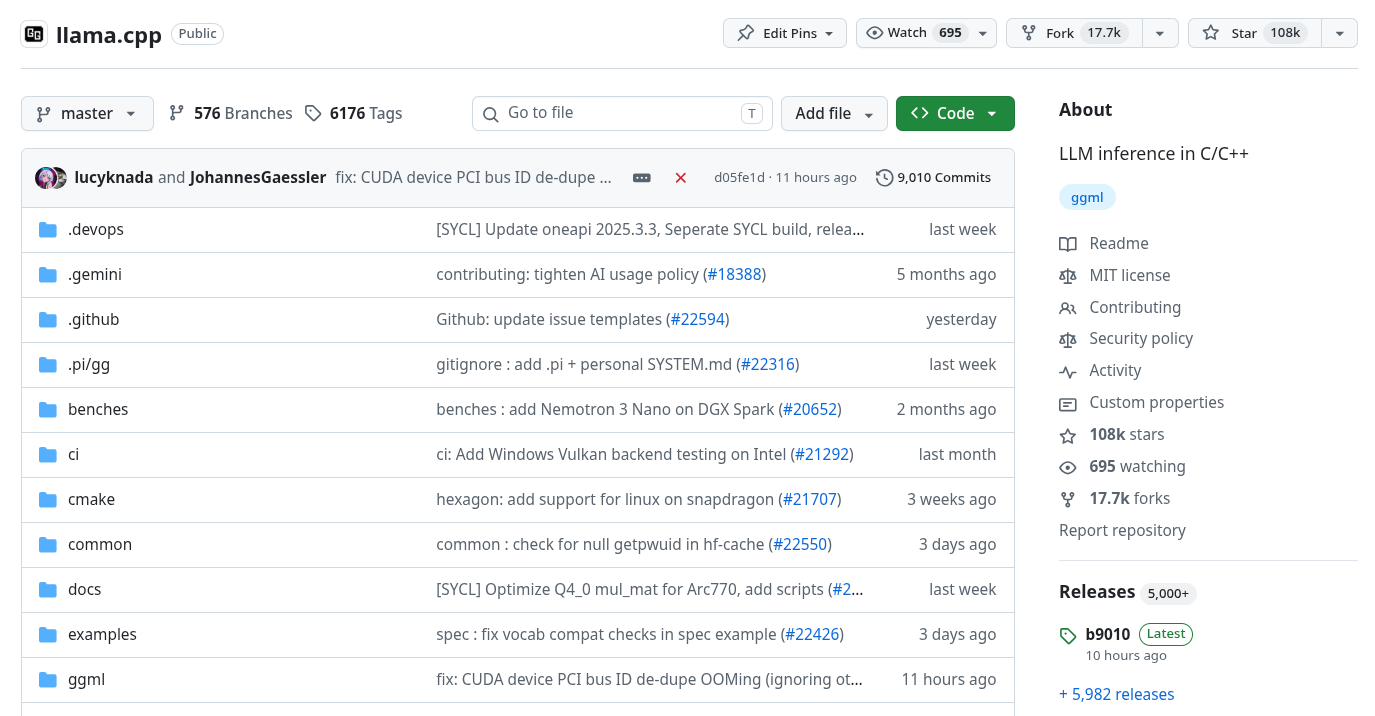
GitHub: ggml-org/llama.cpp
Merged PR: #17737
I worked on a project for the AI Computing Systems course. Over the coursework, I managed to contribute this work to llama.cpp — a large and highly influential open-source repository.
About llama.cpp
llama.cpp is designed to enable LLM inference with minimal setup and state-of-the-art performance on a wide range of hardware — both locally and in the cloud. It is one of the most impactful repositories in the open-source AI ecosystem, with 107k stars and 17.5k forks on GitHub.
What I Did
I implemented the CANN SSM_CONV (State Space Model Convolution) operator on the Ascend NPU, developed by Huawei.
CANN (Compute Architecture for Neural Networks) is Huawei’s software stack for running AI workloads on its Ascend NPUs. Extending CANN support in llama.cpp means Ascend NPU users can now run SSM-based models (such as Mamba) with hardware acceleration.
I wrote the entire operator implementation. My colleague, also a PKU master’s student, handled the documentation. The code was reviewed and merged into the main repository.
It is a great honor to contribute to such a powerful and widely-used open-source project — and I am especially glad to extend the usability of CANN in the broader LLM inference ecosystem.
Technical Details
The operator is implemented in ggml/src/ggml-cann/aclnn_ops.cpp as ggml_cann_ssm_conv.
What SSM_CONV does
SSM_CONV applies a 1D depthwise convolution over the convolution state buffer conv_x, using the learned weights conv1d.weight. This is the convolution step in State Space Models like Mamba — it mixes the recent context window before the SSM recurrence.
Shapes:
src0(conv_x):{d_conv - 1 + n_t, d_inner, n_seqs}— the sliding context buffersrc1(weight):{d_conv, d_inner}— depthwise conv kerneldst:{d_inner, n_t, n_seqs}— output tokens
Key implementation challenges
Tensor layout remapping. ggml stores tensors in row-major order with its own striding conventions, but ACL (Ascend Computing Language) expects tensors in NCL format (batch × channels × length). The three tensors each required a different remapping:
- Input (
acl_x): reinterpret{ncs, nr, n_s}as NCL{n_s, nr, ncs}— straightforward dimension reversal. - Weights (
acl_w): the{d_conv, d_inner}kernel must be presented to the depthwise conv as{d_inner, 1, d_conv}(out_channels, in_channels/group, kernel_size). This required constructing a view with custom strides over the original data without copying. - Output (
acl_y):dstis stored as{d_inner, n_t, n_seqs}(CLN order), but ACL needs NCL{n_seqs, d_inner, n_t}. Achieved by swapping the stride for L and C dimensions in theacl_ydescriptor.
Depthwise convolution parameters. The convolution is depthwise (groups = d_inner), stride 1, no padding (valid convolution) — matching ggml_compute_forward_ssm_conv_f32 exactly.
void ggml_cann_ssm_conv(ggml_backend_cann_context & ctx, ggml_tensor * dst) { // with 1D depthwise convolution
ggml_tensor * src0 = dst->src[0]; // conv_x
ggml_tensor * src1 = dst->src[1]; // conv1d.weight
// This op is currently defined only for F32 in ggml_cpu
GGML_ASSERT(src0->type == GGML_TYPE_F32);
GGML_ASSERT(src1->type == GGML_TYPE_F32);
GGML_ASSERT(dst->type == GGML_TYPE_F32);
// Shapes follow ggml_compute_forward_ssm_conv_f32
const int64_t nc = src1->ne[0]; // d_conv
const int64_t ncs = src0->ne[0]; // d_conv - 1 + n_t
const int64_t nr = src0->ne[1]; // d_inner
const int64_t n_s = src0->ne[2]; // n_seqs
const int64_t n_t = dst->ne[1]; // tokens per sequence
GGML_ASSERT(dst->ne[0] == nr); // dst: {d_inner, n_t, n_s}
GGML_ASSERT(src1->ne[1] == nr); // weight: {d_conv, d_inner}
GGML_ASSERT(ncs == nc - 1 + n_t); // conv_x: {d_conv - 1 + n_t, d_inner, n_s}
GGML_ASSERT(src0->nb[0] == sizeof(float));
GGML_ASSERT(src1->nb[0] == sizeof(float));
// --- Build CANN tensors ---
// 1) Input: conv_x as NCL
//
// src0->ne = { ncs, nr, n_s, 1 } // {L_in, C, N}
// Passing ACL_FORMAT_NCL here means:
// reversed dims -> [N, C, L_in] = [n_s, nr, ncs]
aclTensor * acl_x = ggml_cann_create_tensor(
src0,
src0->ne,
src0->nb,
3,
ACL_FORMAT_NCL
); // {n_seq, d_inner, d_conv -1 + n_t}
// 2) Weights: depthwise conv kernel, view src1 as {K, 1, C}
//
// src1 original: ne = { nc, nr, 1, 1 } // [K, C, 1, 1]
// we want a view: ne_w = { nc, 1, nr } // [K, 1, C]
// so that reversed dims -> [C, 1, K] which matches
// [out_channels, in_channels/groups, kernel_size]
int64_t w_ne[GGML_MAX_DIMS] = { 0 };
size_t w_nb[GGML_MAX_DIMS] = { 0 };
w_ne[0] = nc; // K
w_ne[1] = 1; // 1 input channel per group
w_ne[2] = nr; // C groups
w_ne[3] = 1;
// Layout: src1 data is [K, C] with
// offset(k, c) = k*nb0 + c*nb1
// We want offset_w(k, 0, c) = k*nb0 + c*nb1,
// so we can reuse nb0 and nb1, and set nb2 = nb1.
w_nb[0] = src1->nb[0]; // sizeof(float)
w_nb[1] = src1->nb[1]; // nc * sizeof(float)
w_nb[2] = src1->nb[1]; // same stride for each (fake) "channel"
w_nb[3] = src1->nb[3];
aclTensor * acl_w = ggml_cann_create_tensor(
src1->data,
ggml_cann_type_mapping(src1->type),
ggml_type_size(src1->type),
w_ne,// {nc, 1, nr, 1}
w_nb,
3,
ACL_FORMAT_NCL // {nr=C, 1, nc=K} = {d_inner, 1, d_conv}
);
// 3) Output: dst is { d_inner, n_t, n_s } (CLN)
//
// We need an NCL view of the same buffer:
// desired NCL logical shape: { L_out = n_t, C = nr, N = n_s }
//
// Original CLN layout:
// dst->ne = { nr, n_t, n_s }
// dst->nb[0] = sizeof(float)
// dst->nb[1] = nr * sizeof(float)
// dst->nb[2] = nr * n_t * sizeof(float)
//
// We want offset_new(L, C, N) = offset_orig(C, L, N).
// Choose:
// nb_y[0] = nr * sizeof(float); // step in L
// nb_y[1] = sizeof(float); // step in C
// nb_y[2] = nr * n_t * sizeof(float); // step in N
int64_t y_ne[GGML_MAX_DIMS] = { 0 };
size_t y_nb[GGML_MAX_DIMS] = { 0 };
y_ne[0] = n_t; // L_out
y_ne[1] = nr; // C
y_ne[2] = n_s; // N
y_ne[3] = 1;
y_nb[0] = dst->ne[0] * sizeof(float); // nr * sizeof(float)
y_nb[1] = sizeof(float);
y_nb[2] = dst->ne[0] * dst->ne[1] * sizeof(float); // nr * n_t * sizeof(float)
y_nb[3] = dst->nb[3];
aclTensor * acl_y = ggml_cann_create_tensor(
dst->data,
ggml_cann_type_mapping(dst->type),
ggml_type_size(dst->type),
y_ne,
y_nb, // {n_t,d_inner,n_seq, 1}
3, // {n_t,d_inner,n_seq}
ACL_FORMAT_NCL
); // acl_y = {n_seq, d_inner,n_t}
/** Now we have
* acl_x = {n_seq, d_inner, d_conv -1 + n_t}
acl_w = {d_inner, 1, d_conv}
acl_y = {n_seq, d_inner,n_t}
1D conv output size: L_out =L_in − W + 1
*/
// --- Conv1d parameters: depthwise, stride 1, no padding ("valid") ---
int64_t strideVal[1] = { 1 };
int64_t paddingVal[1] = { 0 };
int64_t dilationVal[1] = { 1 };
aclIntArray * stride = aclCreateIntArray(strideVal, 1);
aclIntArray * padding = aclCreateIntArray(paddingVal, 1);
aclIntArray * dilation = aclCreateIntArray(dilationVal, 1);
const bool transposed = false;
const int64_t groups = nr; // depthwise: one group per inner dim (d_inner group in total)
int8_t cubeMathType = 0;
#ifdef ASCEND_310P
cubeMathType = 1;
#endif
GGML_CANN_CALL_ACLNN_OP(
ctx,
Convolution,
acl_x, // input: N, C, L_in = ncs
acl_w, // weight: [C, 1, K] with groups=nr
nullptr, // bias
stride,
padding,
dilation,
transposed,
padding, // output padding (unused for non-transposed)
groups,
acl_y,
cubeMathType
);
// --- cleanup ---
ACL_CHECK(aclDestroyTensor(acl_x));
ACL_CHECK(aclDestroyTensor(acl_w));
ACL_CHECK(aclDestroyTensor(acl_y));
ACL_CHECK(aclDestroyIntArray(stride));
ACL_CHECK(aclDestroyIntArray(padding));
ACL_CHECK(aclDestroyIntArray(dilation));
}
Result
The implementation passes all correctness checks against the reference CPU kernel and is now live in the llama.cpp main branch, enabling Mamba and other SSM-based models to run with hardware acceleration on Ascend NPUs.